Tuesday, 10 May 2011

Movie Review: Hanna

From Joe Wright, director of Atonement (2007) and Pride and Prejudice (2005), comes Hanna: a thinly disguised fairytale about a young girl trained to be an assassin chasing vengeance against a shady government agent.

Beginning in the snowy wilderness of Finland, Erik Heller (Eric Bana) and his daughter Hanna (Saoirse Ronan) live off the land until the day when Hanna believes she is ready to take on the task of hunting down Marissa Weigler (Cate Blanchett). Letting the Government capture her as her father escapes, she breaks out of a Government facility in Morocco and ends up hitchhiking with an English family. At the same time Marissa Weigler is trying to locate Erik, and sends sadistic serial jumpsuit-wearer Isaacs (Tom Hollander) to track down Hanna.

The character driven narrative is pleasingly European
Powered by wonderful performances, Ronan is totally engaging and Hollander is suitably creepy as the masochistic mercenary; Hanna is a gripping, if slightly disjointed, chase film. The locales are a little trite at times with the overtly friendly locals and native dances and songs that seem to add nothing to the plot; and the film is full with weird accents: nobody quite nailing their chosen language. However despite these minor points the film runs along at a satisfying pace and the action scenes are just as intriguing and beautifully choreographed as the tragic elements and heart that the narrative throws in for good measure. The Chemical Brother’s score is worth note too for its often tense, occasionally obtuse backing; furthering the film’s eclectic and uniquely European style. Films like 2006’s The Lives of Others and Tell No One share its stark sensibilities. Director Joe Wright’s previous productions have gone from average to overwrought, with Atonement making a modern classic into a monumentally boring exercise in missing the point, despite Hanna’s own Saoirse Ronan giving a barnstorming performance as one of literature’s greatest unwitting villains, Briony Tallis. It is interesting then that Hanna is so stylistically arresting, given the director’s penchant for by-numbers adaptations; and the film certainly sets Wright as a British director to watch.

All things considered Hanna as a chase film with heart is top tier, but given the dearth of intelligent thrillers in the cinema right now Hanna is almost required viewing for any fan of character driven action.

Saturday, 7 May 2011

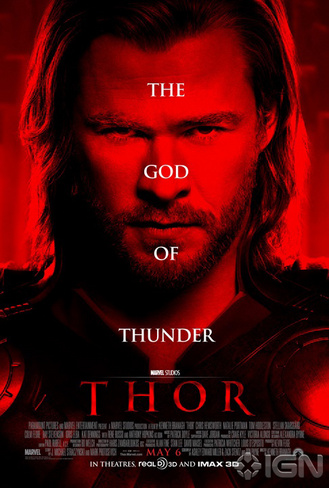
Movie Review: Thor

Thor was always going to be a difficult sell. In the final ultimate super group Marvel Avengers film the Asgard demi-god will be joining forces with tech genius Iron Man, the radiation bloated Hulk and 40’s throwback Captain America; all of which have some grounds in earth-bound science fiction. Thor however is, as the name suggests, a being from another realm: bearer of a mighty hammer and son of Odin who can fly, level buildings and travel through space all without the aid of a suit of improbably powerful computer aided armour, being blasted with gamma radiation or being the result of genetic enhancement. The point is Thor is an alien with all the powers of a god, whereas his peers are humans with powers grounded in scientific experimentation: and in this age of realism based superhero movies like Iron Man (2008) and D.C.’s The Dark Knight (2008), Thor’s flights of fancy may be too fantastical for people to really accept.

Just as Thor (an improbably good-looking Chris Hemsworth), in the realm of Asgard somewhere out in space, is about to take his rightful place as king from his aged father Odin (Anthony Hopkins), the Asgardian’s ancient enemies the Frost Giants break into the Royal Palace and try to steal a powerful weapon. Despite the fact that they fail Thor takes it upon himself to make his way to the Frost Giant’s realm and try to destroy any scent of rebellion within the their ranks. Upon taking the fight to them Odin, who had forbidden his involvement, rescues Thor and his companions, only to strip Thor of his power for his disobedience and cast him down to earth as a mortal. Upon landing he meets physicist Jane Foster (Natalie Portman; getting around isn’t she?) and his journey for redemption begins.


The first act of Thor is back story, setting up Thor’s rise and fall and in general the pontificating and CGI battles are pretty dull, with Anthony Hopkins’ Odin chewing up the scenery in true Shakespearean style. And the Shakespearean style is by no means an accident: director Kenneth Branagh cut his teeth making adaptations and in some ways is a strange choice to direct such a mainstream superhero blockbuster. Once the action is taken to earth however Branagh’s style is truly what makes the film. The fish out of water comedy works wonderfully, with Hemsworth smashing mugs of coffee shouting “ANOTHER!” when he finishes and striding into a Pet Shop and demanding to be given a horse. The opening act is only given any sort of scale once we reach earth, and the battles seem much weightier once Thor becomes a mortal. The cast are reasonably charming and once the opening section is over the comedy and action scenes are excellent; leading to cosmic battle that serves as a satisfying conclusion. Better than The Incredible Hulk (2008) and well in the same league as Iron Man, Thor serves as a meaty introduction to what could have been an incredibly problematic character to introduce: due to Branagh’s masterful comic direction and a likeable cast of misfits.

Monday, 25 April 2011

Movie Review: Your Highness

Your Highness feels a lot like a dated film. Not because of its humour, much of it is as dark and edgy as found in any modern comedy, but because of the way it approaches its subject. Very much in the style of The Princess Bride (1987), Your Highness is a fantasy adventure film with lots of black comedy and stoner jokes thrown in for a modern audience. It is not surprising however that these two very different themes do not sit well together at all.

On returning home from a perilous quest, Fabious (James Franco) is set upon on the day of his wedding by evil wizard Leezar (an unrecognisable Justin Theroux) who steals his bride with a view to fulfilling an ancient prophecy. With his slobbish brother Thadeous (Danny McBride) in tow, they set out on a quest to reclaim the lost princess and destroy the Leezar for good.


The film's fantasy and comedic elements rarely gel.
Your Highness has come under fire for, in a similar way to recent interminable bullshit Sucker Punch (2011), supposedly being sexist and misogynist in its portrayal of women; and as with Sucker Punch, slapping a banner of controversy upon this film is garnering it with attention it does not deserve. Much of the humour is dark, but not outside the realm of Family guy or something similar. Blazing Saddles (1974)’ humour is in many ways much more controversial, and that was made almost 40 years ago. Comparisons with Mel Brookes’ fine send-ups stop there however, as little of the invention or wit of something like Blazing Saddles or Young Frankenstein (1974) is on show in Your Highness. Much of the humour is lost amongst drawn out fight sequences that make the film look like a medium budget, low quality fantasy film, rather than a comedy. There are a few giggles to be had amongst the silliness, but the film ends up being a rather contrived, rather boring exercise stupid dick-jokes and camp nudity and dialog. Academy award winner Natalie Portman and Academy award nominee James Franco seem to enjoy themselves, and most of the funny one-liners come from Danny McBride as Thadeous, despite how utterly hateful his character is. However the film’s warring houses of dark humour and fantasy fun never really come together, and the result is a messy, if occasionally enjoyable trashy farce.

DVD Review: The Illusionist

The line between sentimentality and heartfelt characterisation is a thin one at the best of times. Many directors and writers, Steven Spielberg springs to mind, straddle the dangerous tightrope throughout their career creating some films that are genuinely moving; and others that require the use of a sick bag. The Illusionist, not to be confused with The Illusionist (2006) starring Edward Norton, is a French/British animation directed by Sylvain Chomet and based loosely on an un-filmed Jacques Tati script from 1956. Tati himself has somewhat of a controversial legacy, with his comedy remaining in the hearts of his fans; many of his critics cite his turbulent personal life: and to a certain degree, this is something of a farewell to them.

A French Illusionist living in Paris in the 1950s is beset by unemployment. After a dry spell he travels to England to try to make something of himself; and after making a few contacts ends up in a rainy Scottish village performing for the locals. Amongst them is a young girl who stows away and follows him when he travels to Edinborough, and the two begin a new life in the big city.

The film is often extremely pretty
The first thing that strikes you about The Illusionist is its almost complete lack of dialog: snatches of French and occasionally English are heard throughout the film but nothing in the way of a conversation is ever shown; most of the interactions between characters being visual and indicated by noises. This may seem incidental but it is vital to anyone who hopes to enjoy the film, as the lack of words is occasionally rather alienating, and gives the film a rather empty feeling. The film looks beautiful and the animation is wonderful, but the characters, despite their unique looks, are rather hollow. The Illusionist has the feeling of a short film and, despite being only 76 minutes long, drags rather and the more bleak sections of the film are quite dull. Anybody unfamiliar with Tati’s style of often silent comedy will find the film’s silence boring and frustrating, and many who are aware of his legacy may be put off by the film’s whimsical sentimentality; particularly the movie’s closing few minutes. Less comedic and more lightly sad and occasionally sweet, The Illusionist is a short, if rather dull tale of growing old and that very filmic contrivance of surrogate parenthood; but its narrative never engages in the way of other animations that address such issues like Up (2009) or Howl’s Moving Castle (2004).

Monday, 4 April 2011

Movie Review: Sucker Punch

Watchmen (2009) was a deeply flawed film. Not least because director Zach Snyder, who had shown himself to be an artist when it came to gripping, and crucially fun, action scenes with the stonking Dawn of the Dead remake (2004) and shouty slow-motion-swordfight-porn 300 (2007), lost all directorial sensibilities and allowed his reverence of the source material to smother the style through which he had gained success. Watchmen lacked Zach Snyder, and suffered for it. More Zach Snyder was what we wanted, so Sucker Punch was what we got: possibly one of the most head-achingly stupid mainstream blockbuster to come out in the past 20 years.

Baby Doll (Emily Browning), after being framed for her sister’s murder and cast aside so her greedy step father can inherit her deceased parent’s wealth, is sent to an insane asylum apparently only inhabited by mind-bogglingly pretty girls. As she begins to plan her escape, she finds herself falling into strange and fantastical worlds of zombie soldiers, dragons and robots, as she and her other unbelievably beautiful friends battle to find their freedom.

The dream sequences carry no emotional weight.
If that sounds simple enough, it isn’t. One of the film’s myriad problems is its complete lack of narrative flow. The removal of needless plot exposition is a necessity, but Zach Snyder seems to explain nothing: not until the final, and screamingly unsatisfying, last five or ten minutes do we find out what is really going on. It is unclear as to whether or not the last moments are a plot twist, the tone seems to suggest so; however anybody with half a brain would be able to see exactly what is going on from the start, and as such the middle section of the film carries almost no weight at all. 

Exploitation at 12A. The result: all bark and no bite.
The fact is that all of the Sucker Punch’s stupidities could be forgotten, all of its silliness forgiven, if it had merely had faith in itself. Trite this phrase may be; but one thing that fiction over the decades has taught us is that if the author can make you believe their tale, however fantastical it is, it is ultimately a strong piece of storytelling. Sucker Punch’s confidence neither lies in the real world asylum, too briefly shown to be worth caring about, or its fantasies. The film’s strengths lie in Zach Snyder’s ability to direct action; a World War One inspired scene is particularly well-imagined: but the scenes carry no weight because they’re only in Baby Doll’s head. Neo could die in the Matrix (1999) and that’s why you cared; you knew Sam from Brazil (1985) well enough in the real world to be worried that the fantasies that take him over could overwhelm him: but none of these elements are in Sucker Punch. The fantasies are essentially dreams, so you don’t care, and the real world is something that can’t be controlled so you don’t care about that either. Zach Snyder either needs to have faith in his fantasy, or not dilute his reality, because the upshot is a messy, plotless videogame without the pleasure of interactivity. The pretty girls only stamping home the fact that this is an exploitation movie without the teeth, a two hour music video with some competent action scenes but no cerebral content. 

Sunday, 27 March 2011

Movie Review: Rango

Children’s films these days, in general, don’t feel like children’s films any more. Watching Pinocchio (1940) or even more recent foreign affair like the wonderful My Neighbour Totoro (1988): the plot, characters and look of the film cater to its main audience with care and love, and that is clear from the classic status that both films have garnered around the world, despite their national differences. Classics in every sense because they do what they say on the tin; they’re for children, but for some reason the fashion these days is that you can’t have a children’s film without it being a “family film” too, as if the imagination of children isn’t enough of a challenge to hold. Step in Rango, the new animated film from Gore Verbinski (the Pirates of the Caribbean trilogy and the by-numbers Ring remakes) that marks the first feature film by veteran special effects studios Industrial Light and Magic.

The cast are an ugly bunch, by no means a bad thing.
Thrown from his Vivarium home out of the back of his owner’s swerving car Rango (Johnny Depp), a pet chameleon, finds himself in a desert town populated exclusively by a host of weird and wonderful characters made up of the most bizarre desert creatures. On arrival Rango flexes his acting talents developed by his passion for Shakespeare in his glass enclosure by proclaiming himself to be a wandering hero, and soon becomes the town’s sheriff. Amongst the rumours of roving gangs and the threat of predators like Rattlesnake Jake (Bill Nighy), the town, known simply as dirt, supply of water begins to disappear for unknown reasons. Tasked with the mission of finding this missing amenity vital to the town’s continuing survival, Rango sets out on a journey with a group of the strange townsfolk where he will have to prove his worth to his new friends, and to himself.

The film's surreal sections are more distracting than haunting.
The main problem with a film like Rango is marketing. Expanded upon succinctly and eruditely in his article ‘The problem with poor marketing’*, Sam Manning presents the point that many films in our modern world are not advertised to show necessarily the main qualities of the film they are representing, but to try to appeal to the widest audience possible. This particularly applies to Rango, a film far from the likes of My Neighbour Totoro: advertised, however, as a children’s knockabout comedy. Rango is a film full of dark surrealism, haunting imagery, western referentiality and adult themes that will go over most children’s heads. Not even in the honking, slap in the face fashion of franchise guff like the Shrek films (2001-2010), no mention of pop music or The Matrix (1999) here.  For instance The Fear and Loathing in Las Vegas (1998) reference is cute, and surely made me smile: but not one of the children in the cinema with me would have understood that, and this goes for much of the fun to be had with the film. There just aren’t that many laughs for a film touted as a comedy. Johnny Depp’s Rango is an annoying coward, the references, though sometimes pleasing like the aforementioned, are occasionally too bizarre for the film’s target audience and slow down the film irreparably in the third act. If you approach Rango from the respect of it being an action film akin to Raiders of the Lost Ark (1981) or The Mummy (1999) however, the film seems to gel a lot better and the particularly fine action sequences and the beautiful animation become significantly more fitting.

Referential comedy gone hipster.
Rango is not a film for children. They will neither understand the references or the overarching themes of loneliness, there are too few laughs to please them and the downright ugly characters in the film are a far cry from the cute critters of Finding Nemo (2003) or similar Disney creations. When one distances the film from its advertising as a children’s comedy Rango stands on its own as a perfectly functional animated action film, let down by some heavy handed referentiality, poor marketing and diversions into the bizarre which seem incongruous within the context of the narrative.

Thursday, 17 March 2011

Movie Review: Battle: Los Angeles

It’s very difficult not to compare films sometimes. Sometimes films demand that you look at other films and witness how they did things, then now how the film you’re watching does it differently. Battle: Los Angeles should not have demanded you make those comparisons.

Time: Now. Place: West Coast America. U.S. Marine Staff Sergeant Michael Nantz (An alarmingly chinned Aaron Eckhart) is taking leave of his career after losing men on his final tour. Seemingly coinciding with Nantz’s last day a meteor shower hits earth, spraying the American coastline with lumps of metal that suddenly begin to take shape as an invading force of lumpy aliens. Dragged back into the force the battle begins to save L.A. as Nantz and his squad set out to kick some alien butt.

Despite some interesting looking special effects, and Aaron Eckhart’s watchablity, this film is depressingly dull. Not in the crushing, angry, hair-ripping Transformers: Revenge of the Fallen (2009) sense, merely in the way of this being a missed opportunity. In the wake of rip roaring alien science fiction such as District 9 (2009), crowd pleasers like Avatar (2009) and excellent indie offerings like Monsters (2010); it’s hard to understand why director Jonathan Leibesman has made such a derivative, messy and wholly unsatisfying movie. The first thing that strikes you about the plot is its hackneyed, dull premise. Aliens invade. That’s it. Everything that the film throws at you is saddeningly similar to something you’ve seen before. As alien invasion movies go it’s Independence Day (1996) without the tongue-in-cheek humour, Starship Troopers (1997) without the gleeful satire, or even War of the Worlds (2005) without the skillful narrative direction. Battle: L.A. is a plodding, overly patriotic, overly sentemental mess that’s half an hour too long.